Racquetball and paddleball players have, out of necessity, invented several interesting words and phrases which apply specifically to their sport. It is time someone enumerated on these expressions to facilitate communication among participants and followers. What follows, in alphabetical order, is such a list of phraseology which I have picked up at tournaments throughout the country. Any additions known to readers may be sent to the "IRA Letters" section of this magazine.
CHANDELIER
This often constitutes a hinder and is the word uttered by the referee when the ball strikes the lighting fixtures within the court. The expression originated in Paterson, NJ where the lighting actually consists of an apparatus which hangs down from the ceiling. On these courts the force of a well hit ball into the chandelier brings down a deluge of racquetballs which had previously been trapped within the chandelier itself.
DELAY TACTICS
The means by which a player attempts to stall in order to rest or to throw off his opponent's timing. They include such tactics as asking the referee for an exchange of balls, wetting the ball so it has to be dried before play can resume, or continually serving the ball long into the back wall and then slowly walking after it. Others include faking an injury or sliding your sweaty body along the floor when diving for the ball and then asking for a towel. Wipe the floor slowly. Another old dependable that many players have long employed is tying one's already tied shoe laces.
DONUT
This was actually originated by handball's Paul Haber as far as I can determine and is synonymous with "zero" when referring to the score attained by one's opponent.
DONKEY KICK SHOT
Perhaps the most difficult shot ever to be invented, this was improvised by Charlie Brumfield, racquetball's International champion. The "Brum's" friends had made mention of the donkey shot previously, but the first time I witnessed its utilization was against myself last summer. With the ball coming to Charlie's right side almost out of reach and near the right side wall, Brumfield dived and rolled the ball off, at the same time (while flying in the air) pushed off the side wall and tripped up my legs with his (the "donkey kick") as I attempted to cover the ball. I have experienced nothing to compare with the humiliation of being the victim of the donkey kick shot.
FATIGUE FACTOR
The element of extreme lassitude which usually becomes apparent in the final game of a grueling three game match. Example: the 1970 National Paddleball tournament had Craig Finger playing Brumfield in the finals. Brumfield had run Finger throughout the match and in the third game Craig could at best wearily respond by using the back wall for support while awaiting Brumfield's serve. This is the fatigue factor at its ultimate. As a post script, Craig got even with Charlie by defeating him in that same year's racquetball tourney en route to the International championship.
FREAK BALL
An out of the ordinary shot hit from an out of the ordinary position for a rolloff. Example: the three-quarter court backhand overhead rolloff into the right hand corner.
FRONT COURT POSITION
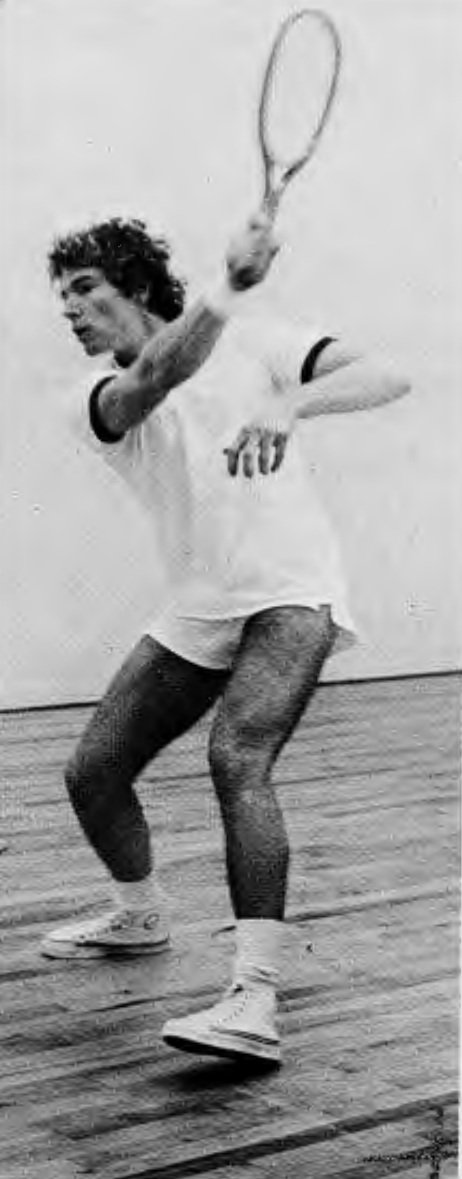
This, according to the game's master strategist, Dr. Bud Muehleisen, is the key to winning doubles. It simply involves maintaining position in front of your opponents (in the region of the service box) and waiting for the plum ball set up (see later under "plum ball"). If your competitors have front court position drive them back with a lob or ceiling ball and regain the territory.
GARFINKEL SERVE
The serve employed by Charlie Garfinkel of Buffalo to defeat the highly favored Brumfield in the 1971 International racquetball tourney in Salt Lake City. This service appears to be very ineffective from anywhere but the receiver's standpoint (especially since it is to the receiver's forehand). The person serving stands in the middle of the service box and essentially serves an around-the-wall ball (Z-ball). That is, the ball goes front wall to left side wall and into deep backcourt on the right side. Easily executed and difficult to offensively return, the Garfinkel serve requires but a few practice hits to master.
ISOLATION BALL
This is the strategy utilized in doubles play which involves hitting almost every shot to one player. The result is the picked-on player undergoes the fatigue factor and his partner becomes so mentally bored from not hitting the ball that he is unprepared for even the most routine plum ball. In national paddleball doubles competition the isolation factor is employed much of the time among the better teams.
PLUM BALL
The synonyms for this term include "easy shot", "pumpkin ball", "routine set up" and the "90% roll off".
This concludes the first half of the alphabet. The next issue of Racquetball will contain the remainder of the list of expressions with which every racquet and paddle player should familiarize himself. Look in the next issue for such terms as superpinch, tour of the court, veteran hinder, wallpaper ball and others.
Originally published in Racquetball, Volume I, Number 1, November 1972, p. 31. By Steve Keeley.