ABC’s . The ABC’s of were invented by my most unforgettable _personality, Carl Loveday of San Diego . Loveday ‘s present claim to fame is that he is one-half of the current Masters dou – bles championship team . His past claims to fame must go unheralded here, lest this publication lose its “G ” rating . At 52-years-old , the cigar-puffing , potbellied (see cover , January, 1973 ) veteran resembles a white whale on the court , with an unique ability for never moving after, but always getting to, the ball. The ABC ‘s, I recently discovered, stand for Always Believe Carl. Present national champion Charlie Brumfield was taught the game by Bud Muehleisen , the first national champ. Bud was taught the game by Loveday. For this reason I believe in the ABC ‘s of . AROUND-THE-WALL-Z-BALL. Peruse the following 50 or so words and then forget them. Do not practice this shot; it is simply an accidental mutation of the around-the-wall ball and requires a very lively ball (“Superball”) to even come close to becoming a reality. The shot was first witnessed in the most recent Nationals after being hit by George Rudysz in a doubles match. George hit one of his vapor balls and by the time the 16
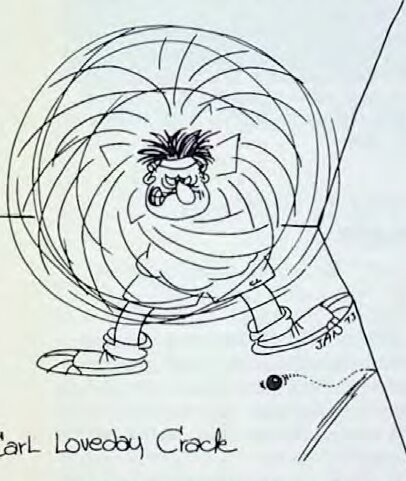
ball slowed down enought to be visible the gallery was in shock . ” Did you see that?! ” was the incredulous murmur . ” The ball hit four walls! ” As it is hit by George , the ball flys off the right side wall-front wall-left side wall-right side wall -floor . By the time the ball completes its aerial acrobatics the person awaiting its return has Either been hyponotized or has twisted his body into something that resembles a pretzel holding a racquet. As a corollary I have witnessed the around-the-wall-Z-ball hit such occas ionally aided by your oppothat the ball actually strikes four side nents incompetent judgment on a walls (i.e., each side wall twice) dur – ing its tour of the upper atmosphere of the court. If you have five (or find that you subsequently hit you r more) free minutes, attempt to dia – next shot for a lucky kill or other gram or think this one out. freak ball. If this happens , gesture CHABOT TIME OUT. This portoward the heavens , scream “God ‘s trays perfectly the ” psyche factor ” Will!” , directly into your opponent ‘s in action . Chabot is the mid-coast face, and serve the ball with divinely California college where this little insp ired conf idence. ruse arose. To execute the Chabot time out, one must be awaiting serthinking things like (to paraphrase vice. As the server drops the ball my eighth grade history text) “If God and is about to strike it you yell is with him , who can be aga ins t ” Chabot Time Out ” . It’s the tim ing him? ” In short, your competitor is that gets ’em . I have seen grown psyched out. Synonyms: “Justi c e is players shake , from served ,” and ” God knows !” being so upset by this untimely time out. I have seen younger players break down and shed tears of frusABC ‘s is the only player I know who tration. The Chabot t ime out is guaranteed to break your comwal l and floor on pass shots , and petitor ‘s concentration. GOD’S WILL. Another psych of that mag ic touch . Time after time sorts orginated , I believe, in San Diego and now hundreds of players strikes the crack at midcourt and the across the country benefit from its effects . I’m sure each reader has been in a position at some time on the court when a referee ‘s decision foregoing : 1) Carl yells “God ‘s will!” (see “White Cane Award”) has gone against him on a “bad” call, or 2) someone in the gallery pipes
Gods WiLL near skip ball, etc . The next time this occurs you may Your opponent will most likely be CARL LOVEDAY CRACK. Ca rl Loveday, referred to above in the aims for the crack between the side consistently hits them . He just has he will hit a cross court drive w!”iich ball trickles or freaks out. On San Diego courts one of two things happen after Loveday performs the (to his opponent’s embarrassment)
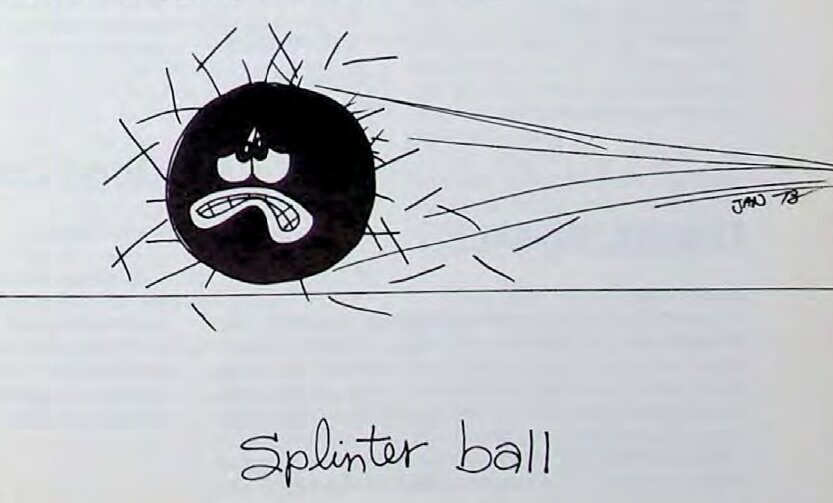
up, “Its Loveday’s crack ” (to Carl’s chagrin). This type of humor would no doubt be interpreted as psychopathic in many societies, with its proponents being thrown straight jackets . SELF WAFFLE. In other publications I described a ··waffle ” as the impression left by the racquet strings after hitting a person’s body (and ably illustrated by Jan Campbell. The SELF waffle is fairly self descriptive . The foremost advocate of this play is my doubles partner , Charlie Drake. In practicing for the recent Nationals, Drake and I were playing a pickup game against Brumf ield and Muehleisen . On one particular ly exciting rally the ball was somehow (e ·r ·- …….· Carl Lo~ Crac.l. partially screened from Drake ‘s vision. This resulted in ” Chaz the Spaz ” swatting thrice and m issing before finally connecting on the fourth swing. That is, he connected with his own face, splitting open his lower lip (which later required four stitches) . This turned out to be only a warm – up for the Nationals , however. In our third round doubles match Charlie again administered the self waffle. This time he chipped a tooth (which later required capping). SPLINTER BALL. An euphem – ism for a skip ball. This is an attempted kill shot which hits the floor just prior to rolling off the front wall. In St. Louis a player will pick up the ball after such a shot and methodically remove imaginary wooden floor splinters from it as proof that his competitor’s
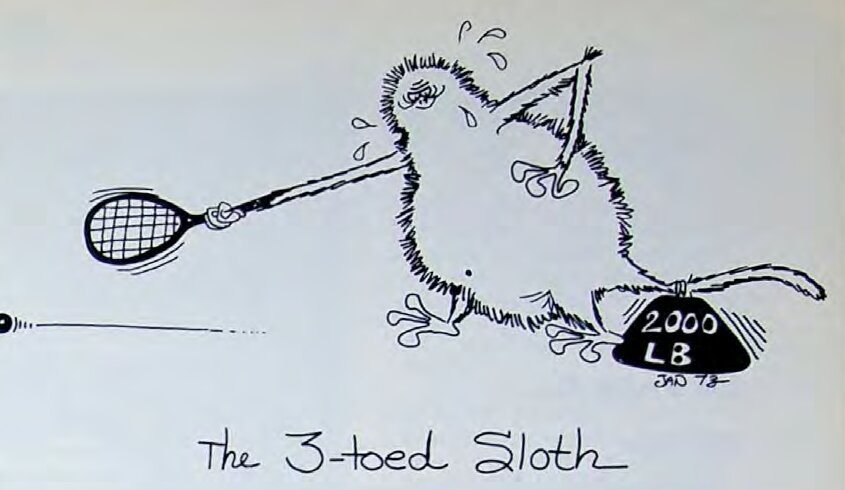
into OJ,,,______ The-3–toecL~Jot_h_ skipped in. Other synonyms : dirt ball , ground ball, oil well ball. THREE-TOED SLOTH. For those who attended the Nationa ls in St. Louis , you may have noticed the Californ ia contingency per iodically giv ing what appeared to me to be an upside down boy scout threefingered officia l salute. You veteran boy scou ts know to wh at I am referring . Upon inqu iry as to what this gesture signified , I received the folment referee who makes continulowing exp lanat ion : “According to the Gueniess Book of World Records the three-toed sloth is the world’s slowest land mammal , traveling at six to eight feet per minute .” Thus I realized why they flashed their three finger gester at me when I plodded and plundered around the court in a manner that is inherant to only myself and this North American mouse . As a postscript I was told , shot
(>,-,c::, -~,il•~ ) Al g.h~~f D- ‘ti ~~ “In case of crucial situations such as when its babies are being attacked , the three-toed sloth is able to almost double its normal speed to an amazing 14 feet per minute. ” In such a groove does the San Diego mind run ; it never ceases to amaze me. WHITE CANE AWARD . That rare honor bequested on any tournaous misca lls on skip balls , hinders and things like that there . The above group of terms is, along with other related words and phrases an integral part of one’s repertoire. Players who wish to become a part of the “i n” group must master the game ‘s slang. For once you have learned the lingo, your game can’t be far behind. 17
Originally published in National Racquetball, September 1973, pp. 16–17. By Steve Keeley. Illustrations by Jan Campbell.