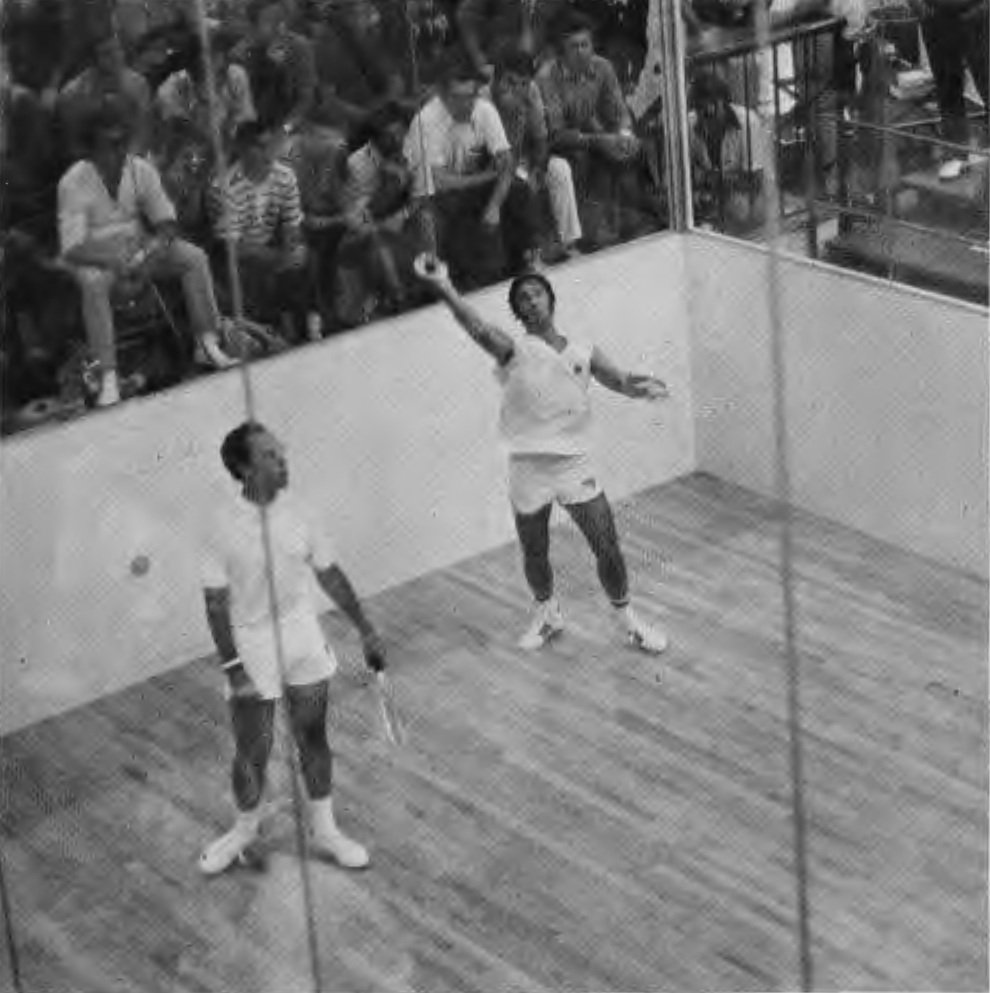
For the winner it was redemption, glory and satisfaction. For the loser, disgust and obscenities. For the fans, excitement, cheers and awe. All this and more when Dr. Bud Muehleisen defeated Paul Haber in the second of their continuing series of hands vs. racquet matches, at the grand opening of Ben Agajanian's Long Beach Athletic Club in Long Beach, California.
The 41-year-old dentist topped handball's ex-champ 21-9, 18-21, 21-8 in a thrilling exhibition of both racquetball and handball skill September 17 before over 400 howling handball/racquetball enthusiasts.
As the scores indicate games one and three were all Muehleisen and game two was a battle royal. Each man had something to prove, Muehleisen to himself and his followers that the loss to Haber in Memphis earlier this year (Handball, February, 1972) was not the true exhibition of his game; and Haber, that such a victory was no fluke.
Significant by its absence in this match was the lack of wagering by proponents of either hands or racquet. Early in the exhibition week Haber let word out that his game was not "on" and consequently there was no off-court action. That is until minutes before game time when the opposite prediction came from the lips of the five time U.S.H.A. titleholder. A rush of dickering installed Muehleisen as six point favorite, a line that held up.
Game one stretched 18 innings and was not in doubt from its mid-point. Muehleisen combined hard drives, back wall kills and dump kills to keep Haber off balance and defensive the entire game.
Before either man could break a sweat, Paul forged two aces, a pass and two kills into a 5-1 lead, and then managed only one point over the next 12 innings. Dr. Bud used a hard, low drive serve to both the left and right to obtain weak returns which he often put away.
Haber, as he did in the first encounter, gave Muehleisen more than enough room to shoot, laying back for the live handball's caroms off the back wall. But his offensive game was not there, his kills off the back wall were left two and three feet high and Muehleisen put away at least five drop shot re-kills that were impossible for Paul, in deep court, to cover.
Bud's run of 10 points in the tenth through twelfth innings put the game out of reach. He had good control, especially in retrieving Haber ceiling balls to his backhand, the one specific shot that was the key to his first match loss. Haber, on the other hand, could not come through when he had the shots, especially off the back wall.
First game, to the racquet, in a breeze.
Game two should have been a Muehleisen rout. He came out confident, not cocky as in Memphis. This time he was aware of Haber's great skill and potential to "get a hot streak." This time, said observers, there would be no hot streak.
And it seemed so when Bud grabbed the early advantage, and held it through the first 10 innings. Again, minimizing his errors, electing to go around the walls, rather than risk the troublesome ceiling returns, was the key to his success. Haber's futility was full, to the extent of the Chicagoan double shorting his service in the eighth frame.
Then a change occurred, at 13-4 Muehleisen advantage. It was either Haber becoming aggressive, or Muehleisen relaxing with his lead, or both. In any event, Paul did get his streak, much to the delight of the handball section of the crowd.
In the 11th inning Paul killed off the back wall with his left for point five. A Muehleisen backhand error made it six, and an ace to the backhand, seven. Haber then killed twice, once with his right, and then with his left off the back wall to close to within 9-13 before being put out.
A weak backhand return gave Haber a kill attempt which he put away and regained the service in the twelfth. Again he tallied five times. A kill with the right was point 10, Muehleisen error off the serve, 11, another Muehleisen error, this one with his backhand for point 12 and a time-out for the San Diegan.
Haber came back after the time-out and tallied twice more, both kills, both with the left to grab the lead, 14-13. Again Muehleisen could not score and Haber regained the serve with a pass right. At this time Bud was not being effective. Haber had control of the rallies, forcing weak or poor returns and taking advantage of back wall set-ups.
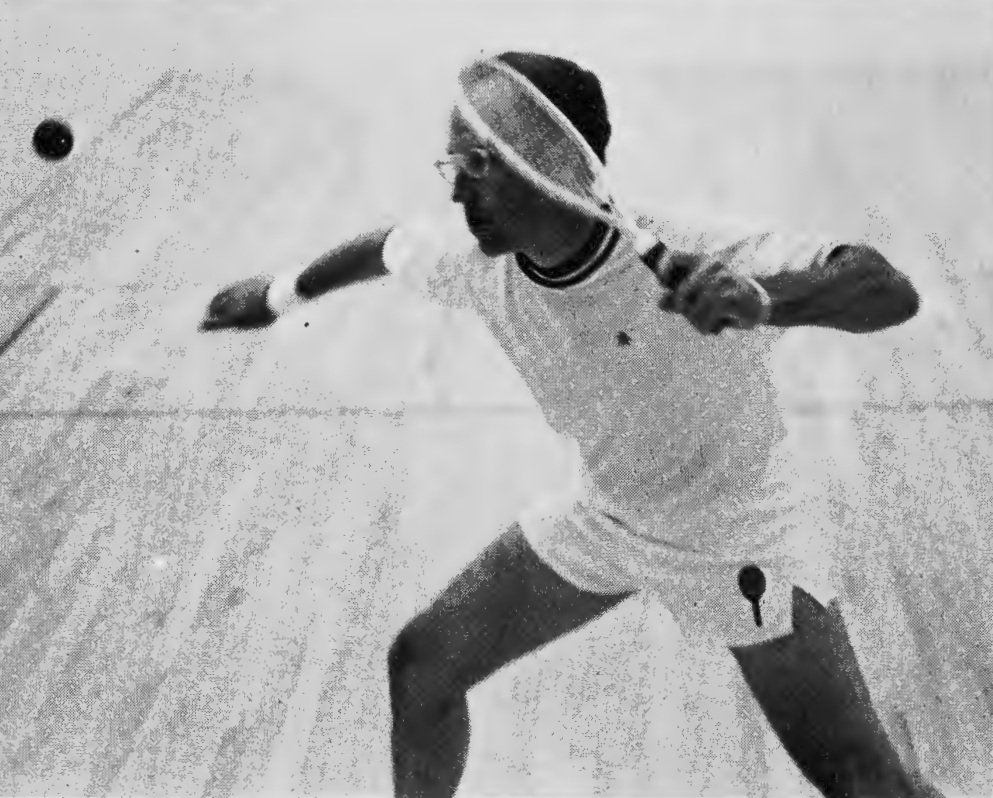
Just as in Memphis, Muehleisen seemed to be too powerful with his racquet, hitting so hard that the ball always came off the back wall. Thus in the 13th inning Haber connected on two straight back wall kills and then his "patented" left hand left corner kill to forge to a 17-13 edge. It didn't last.
Dr. Bud came back with a backhand kill in the bottom of the 13th making it 14-17. Then in the 15th frame he tallied three times, a forehand kill, an ace, and a pass left to knot the score at 17-all.
The combatants traded points in the next inning and then Haber rallied for the necessary three points in the 17th frame. They came on two Muehleisen errors, and a kill to end it.
"He just got a hot streak," said the racquetball Masters champion.
It was more than that, however. Haber's decision to play offensive, becoming the shooter, was decided on two factors. First, his control was off, especially to the ceiling. Ceiling balls to the right (backhand) were not troubling Muehleisen as they had in Memphis, with Bud slashing them around the walls, forcing a defensive return. Secondly, it is punishing to play the retrieve type game Haber was playing against the racquet, and Haber well remembered the near-exhaustion he suffered after their first match.
Thus he became a shooter, gambling that he would hit his kills. He did hit some, and the game's change of pace forced Muehleisen errors for the other points.
In game three, however, Muehleisen adjusted his game slightly, using hard drive serves to Haber's right and finally using the pass to his advantage. To this point, Bud had harnessed his power. He finally let it all hang out.
At one-all in the third inning, Muehleisen ran six points gaining a margin he never relinquished. Three kills and three passes counted in the scoring. They traded points or no points for the next few innings until Haber made an abbreviated "move," closing from 13-5 to 14-8.
But the show was over. Spurred on by the cries of "all the way, Bud," the former I.R.A. open singles champ plowed straight for 21. Haber never regained the serve, as Dr. Bud played letter-perfect racquetball, or handball, tallying a forehand kill for 15, an ace to the right for 16, a back wall kill for 17, two Haber errors to 20 and a pass right for the magic 21.
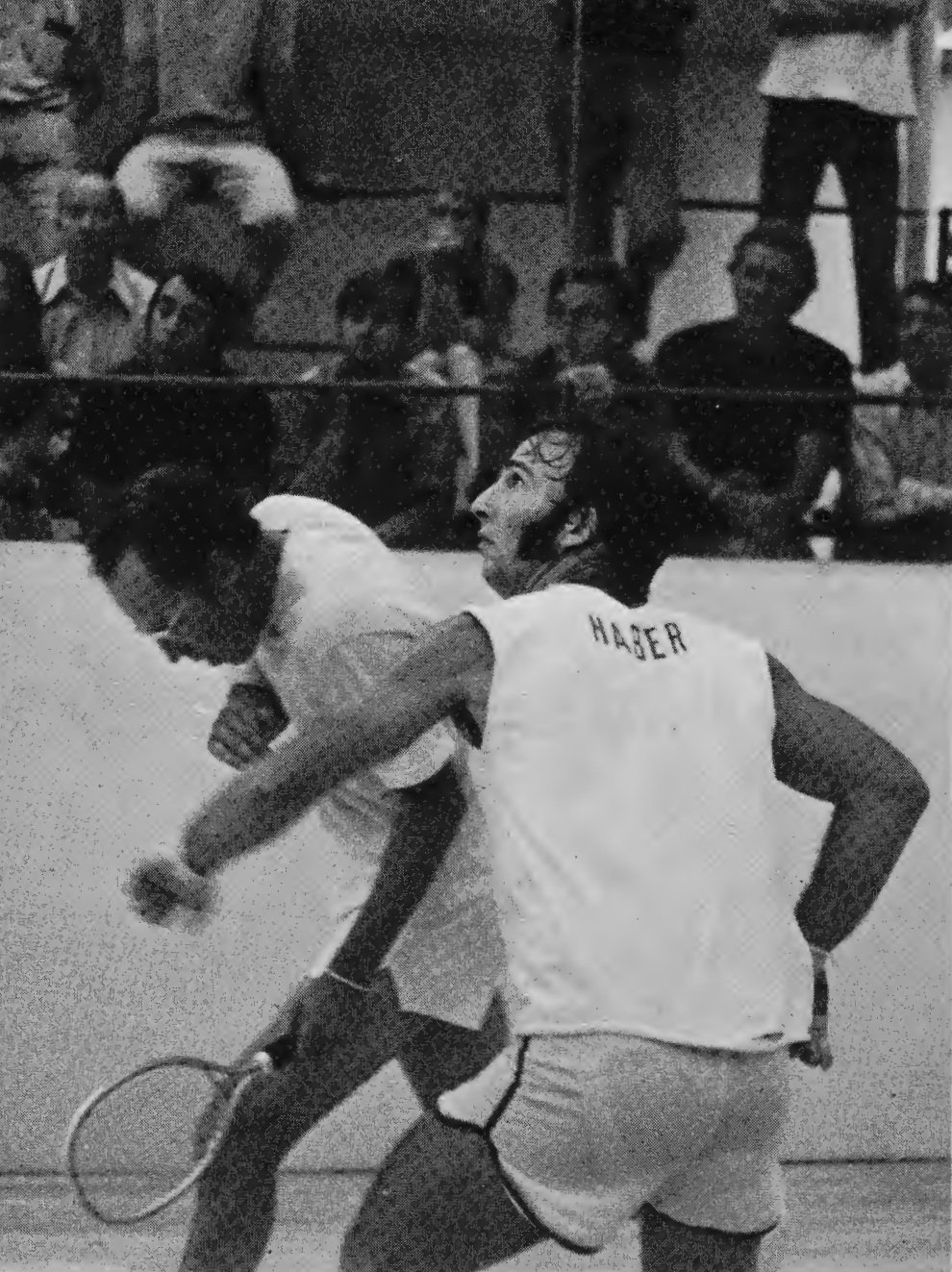
"I didn't really play all that well," said Muehleisen after the match. And although most observers took the comment tongue-in-cheek, the statistics actually prove Bud out. He out-erred Haber 32-21 in the three games and actually felt he should have won in two straight.
Haber, although consoled by everyone in sight, including I.R.A. and U.S.H.A. president Bob Kendler was disgusted with his game.
"I played like a big bleep," he said over a tall cold one. "I really thought I could beat him, especially after the second game."
To console the handballers, Haber's game was not sharp. The circulating "excuse" was that he had spent the past four months playing outdoor three-wall in preparation for the U.S.H.A. National 3-Wall tournament in Detroit Labor Day weekend. Consequently, his control and back wall shooting, which were both poor, suffered.
At the other end of the spectrum, however, Muehleisen had only two weeks to prepare for using an unfamiliar ball, the handball. Only two weeks, because prior to that was the I.R.A. Masters Invitational Singles tournament (page 18), which he won.
So both men hope to be at peak form for the third and decisive match as yet undetermined in sight and date.
Notes: Bob Kendler was honored by Ben Agajanian with the dedication of the 600-plus seating court five at Aggie's Long Beach A.C. Kendler returned the favor with a warm acceptance speech in Aggie's behalf … Agajanian has put together the ultimate in court clubs. It's plush yet practical and he has good men, led by Ed Kelly, to lend a hand. … Our thanks to Mel Gorham, also of court club fame, for his hospitality … Kendler and Chuck Leve returned to San Diego for meetings with key racquet manufacturers there and inspection of club facilities, while Mort Leve and Dan Callahan, U.S.H.A. Rules and Referee's Chairman, went north to Portland to check out the Multnomah A.C. as possible site for the handball nationals … Gorham is bidding for the same in racquetball at his now under construction, eight court facility in Oceanside, California.
Referee of the match was ex-handball national champ (1968) Stuffy Singer. He did a good job, controlling the match and letting no one get away with anything illegitimate … In preliminary play, Charlie Brumfield, I.R.A. open singles champ, defeated Roger Souders 31-9 and Jan Campbell, ranking third among I.R.A. women, topped Bette Weed … In handball prelim Dr. Steve August bested U.S.H.A. national champ Fred Lewis 31-17. Lewis was nursing a shoulder injury.
GAME ONE
MUEHLEISEN: 0 0 1 2 0 1 0 0 0 3 5 2 0 2 0 1 2 2 — 21
HABER: 2 1 2 0 0 0 0 1 0 0 0 0 0 0 0 2 1 x — 9
Kills—Muehleisen 20, Haber 9. Passes—Muehleisen 5, Haber 1. Errors—Muehleisen 12, Haber 8. Aces—Muehleisen 3, Haber 2. Time-outs—Haber 2. Hinders—9.
GAME TWO
HABER: 1 0 0 1 1 0 0 0 1 0 5 5 3 0 0 1 3 — 21
MUEHLEISEN: 2 0 1 4 3 2 1 0 0 0 0 0 1 0 3 1 x — 18
Kills—Haber 18, Muehleisen 11. Passes—Haber 4, Muehleisen 8. Errors—Haber 6, Muehleisen 13. Aces—Haber 2, Muehleisen 1. Time-outs—Haber 2, Muehleisen 1. Hinders—6.
GAME THREE
MUEHLEISEN: 0 6 2 0 1 0 1 2 7 — 21
HABER: 0 1 2 0 0 0 0 2 2 x — 8
Kills—Muehleisen 13, Haber 11. Passes—Muehleisen 8, Haber 0. Errors—Muehleisen 7, Haber 7. Aces—Muehleisen 1, Haber 1. Time-outs—Haber 1. Hinders—4.
Originally published in Racquetball, Volume I, Number 1, November 1972, pp. 14–16. No author byline printed.