Hands against racquet, what does it prove? In reality, nothing.
Paul Haber has proved he has guts, competitiveness and tremendous handball skill. Dr. Bud Muehleisen has proved he can adapt to the bounce of the handball, that he can hit the handball over 200 miles per hour with his racquet, and that he, too has tremendous skill.
But these things were known before they ever started their series of matches. The personalities quite obviously were as different as rain and shine and that only made the match more interesting.
Yet, the matches did not mean that handball players are better than racquetball or the reverse. Hands versus racquet can be interesting, challenging and extremely entertaining. But it is this editor's feeling that the rubber match between Haber and Muehleisen should be their last.
The original goal of the entire series has already been achieved, that of national publicity for both sports. A leading sports magazine carried two full pages on the initial match, and a smaller article on the second. We believe top coverage will accompany the third.
Why, then, should it be the last? Because the more it is played by Paul and Bud, the more publicity it gains, the more people want to try it. And we are not in for promoting hands versus racquet in any manner.
In fact, hands against racquet matches should be attempted only by the highly skilled, and no one else. Even the rank beginning racquetballer can propel the handball 150-plus miles per hour with his racquet. And unless both players are extremely capable not only in skill, but court etiquette as well, the chance of injury is good, and serious, crippling injury possible.
The handball is a foreign object to a racquetballer. The ball is harder, livelier and smaller, bounces higher and travels faster than does the racquetball. For these reasons the racquetball player has far less control with a handball than he would with a racquetball. And this means far greater chance of hitting the handball player with the ball.
The handballer in such matches is not used to the fantastic speed that the handball can gather. This speed makes the ball carom sometimes wildly around the court. Also the handballer must adjust his style of play against a racquet, laying back rather than charge. Can you imagine a player charging to cover an expected kill attempt and instead facing a pass directly at him?
Winning cannot be all-important in hands against racquet matches, safety must be the first consideration. At least a half-dozen times in their first two meetings, Dr. Muehleisen has altered his return, just to be sure of not hitting Haber with the ball. The difference is slight,—a ceiling ball instead of a drive, down the line instead of cross court. Yet the inexperienced player, wholly devoted to winning may not be able to or may not want to alter his shot. The result will be injury.
And there is too much injury already among beginners in the game today; we need no more.
* * *
Two tournament biggies this month, the Canadian Nationals in Vancouver and the Masters Invitational Doubles in New Castle, Pa. Both should let loose with a barrage of fine play, with most of the game's top singles players on hand in Vancouver, while the nation's best Masters do battle in New Castle.
Paddleball Divisional sites and dates are still being lined up, and paddleballers will be notified by mail as to the closest paddleball divisional to them. Winners, for the first time, of open singles and open doubles will receive round trip air fare to the N.P.A. Nationals (page 26).
December brings the rapidly-becoming-influential Holiday tournament in San Diego, being hosted by Mel Gorham's Sports Center. Mel and the west coast gang anticipate a couple of hundred entries, including women (would there be a Gorham's tourney without them?).
"I plan to make this tournament second in importance only to the I.R.A. Internationals," said Gorham recently.
Knowing Mel, he can do it.
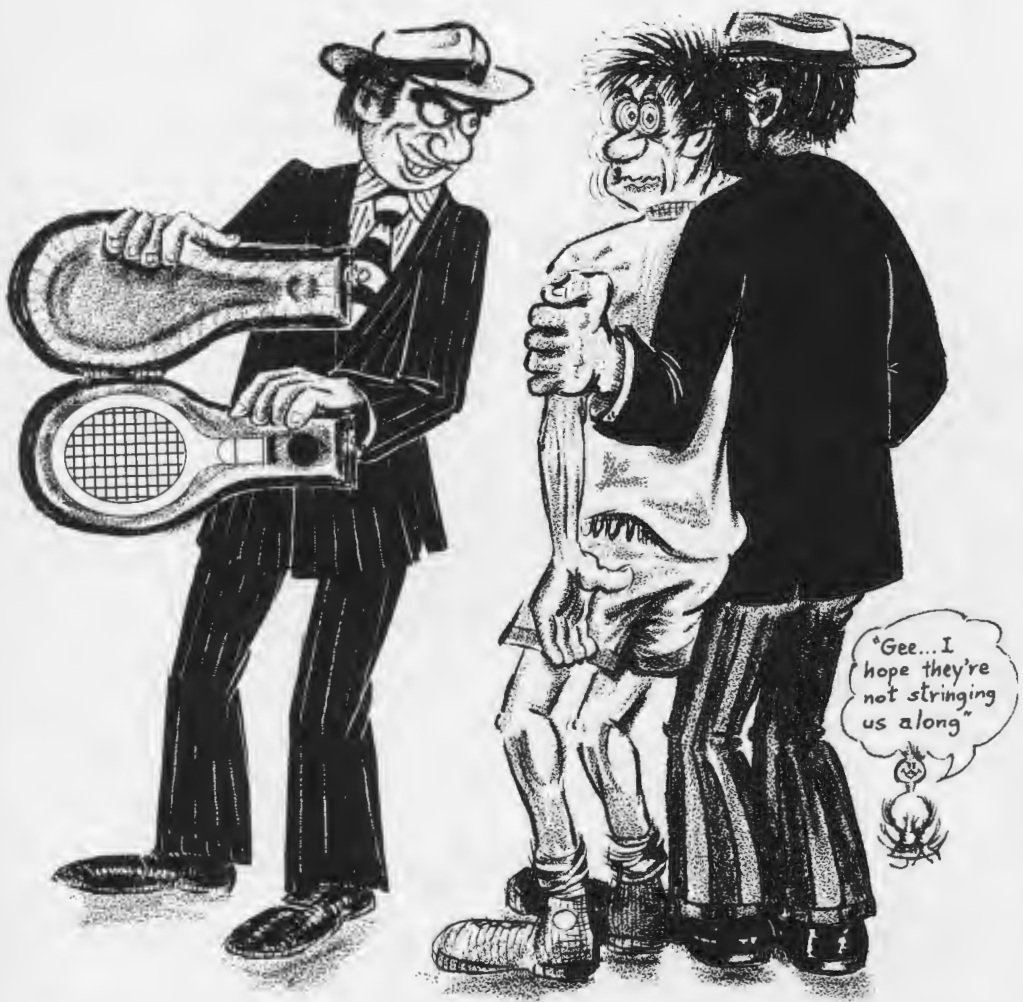
Originally published in Racquetball, Volume I, Number 1, November 1972, p. 21. By Chuck Leve. Cartoon reproduced from the same page.