Okay, you have practiced, in your own manner, and have now arrived at a tournament. First of all, your confidence should be high enough that you think you can win your first match. What can you do before and during this first and hopefully later matches, that will assure you of producing the best performance you can from the talent which you possess?
There are two periods in which you will have to regulate your mental confidence and motivation. The first is pre-match, the second, during the match.
For the pre-match and match beginning, one of the simplest and least thought about factors that can regulate performance is tension. Psychologists have known for years that a little tension can improve performance, but a lot of tension actually hurts performance in a skilled task. Therefore, it is not particularly good to be too tense or nervous. What is desired is a mild, controlled level of tension and confidence. A little tension is better than none at all.
If you feel yourself getting too nervous, just remind yourself of your strong points and the offense you will use to defeat your opponent. You will soon find that all you can ask of yourself is to play your best. If you do that you will have nothing to be wary or mad about, whether you win or lose.
On the other hand, if you do not feel any pregame tension, then it's time to start worrying. Perhaps you should think about your opponent's strengths and how you will counter them. But whatever you do, DO NOT WORRY ABOUT LOSING. If you worry about losing, then you are beginning to doubt your own ability, and this negative thinking will be the last thing on your mind before each shot. You will have enough to think about on the court without the added worry of losing. Besides, when you think about the match, your opponent, strategy, etc., it makes you more aware of the factors in the match and might help you see the factor that will help you to win.
In addition, you should fully expect any match between yourself and an equally skilled or better player to be a physically demanding match. That is part of what the whole game is about. Set your sights on some hard, fast running. You must be in condition when you step on the court: it should not be on your mind before or during a match. Besides, running is supposed to be good, that is, it feels good when you stop. So, enjoy it.
"During the match" psychology of building confidence and the will to win can be manipulated in different ways. Few of the top players today follow the same methods of "getting up" and "staying up." Each has his own style of self-motivation. You should choose the manner which best fits you.
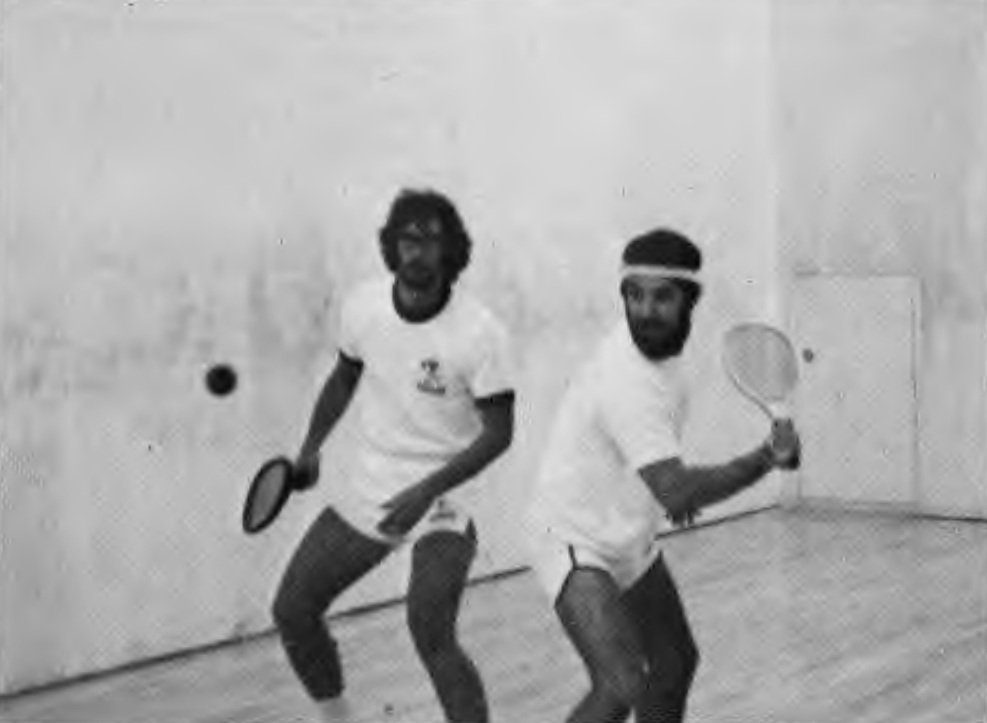
TAKE THE OFFENSIVE.
This is the first and most evident way of sustaining your momentum or breaking a losing streak. Percentages indicate that it is hard to win points when your opponent has you off balance and running all over the court, playing defense. Go for a few winners and you will feel better, and you will both fatigue and worry your opponent, if you are successful.
CONTROL THE PLAY.
Right from the start of the match try to establish total dominance and control of the play. This can be done by either showing offensively you can move your opponent at will, or defensively that you can retrieve any shot that your opponent can hit. Such total dominance is a way of intimidating your opponent. When he realizes he has virtually no control of the match, this can seriously break his spirit and turn the game into a rout in your favor.
If you can establish dominance and control of the match by retrieving everything, then you may force your opponent to become impatient and err. If his conditioning is not as good, he may not be able to trade 30 strokes per point with you without succumbing to the fatigue factor.
GET THE TURNING POINTS.
You have all heard of the so-called turning point in a match in a racquet sport. Well, it is rare that any one point can ever be exactly pin-pointed in a match, unless it comes at a 20-20 situation. However, there are often several important points played in each game or match. An important point would be one which would place one player far enough ahead of his opponent that he now has a safety margin to rest on. The leading player can then shoot freely and the trailing player must play errorless racquetball.
So, take note of these important points, and occasionally gamble on them. If you win the gamble and hit a winner then you have added to your opponent's notion that you are not a choke and that you can win the important point when you have to. And if you do win the point, then you have proven to yourself that you can hit winners and this helps build confidence.
PLAY FUNDAMENTALLY CORRECT.
If all else fails, or if you are the type of player who plays better totally relaxed, then forget about the match score and concentrate more on fundamentals. Keep your eye on the ball, lean into it, stroke smoothly and enjoy just hitting the ball well. Perhaps what was wrong with your game was something fundamental that you had overlooked or were careless about in the heat of battle. Concentrate on playing well and not on losing.
When the tournament is over and whether you have won or lost, why not take a break? If you are losing and can't figure out why, maybe you are over-racquetballed. It can happen to even the best. Take however long is necessary. Jog, swim or do something else to stay loose and relaxed, and just wait until the urge to play comes back. It will, so don't worry, and you will come back stronger because of it. You will forget your old errors and your confidence will come back with your game.
Originally published in Racquetball, Volume I, Number 1, November 1972, p. 34. By Craig Finger and Paul Lawrence. The second of a two-part series; part 1 appeared in August Handball Magazine.