What makes an excellent racquetball player? What quality, if there is a single identifiable one, does a champion possess? It is almost impossible to isolate one quality; it is more logical to examine some of the components that comprise a good player. The ability to execute the skills pertaining to the game probably ranks foremost as the single most important factor. However, in order to execute the skills, a capable player must have the ability to react to each play; reaction time is another prized component. The ability to think, to analyze each situation, to plan strategy, and to modify the plans as the game evolves is another valuable characteristic of a competent player. There is a psychological aspect, which can be described as the development of specific character traits such as mental toughness, determination, perseverence, even temperedness and inventiveness, that could be added to the list of desirable components. A player could posses all of the fine qualities mentioned above and yet all of these attributes by themselves, are insufficient to make him a champion if he lacks a high level of physical fitness. Players who are in poor physical condition tire qu ickly. It is well documented that fatigue erodes skill execution, slows down reaction time, and even if thinking and analyzing are not affected, the muscles cannot respond fully to the neural messages from the brain. All the laudable character traits mentioned above are insufficient and ineffectual if the muscles cannot carry the body around the court. How to attain a top level of physical fitness is not a secret known to only a select few. Most people, and all athletes, know that hard work, over a long period of time, is required to reach the peak level of fitness. Playing oneself into shape may be satisfactory for the recreational racquetballer-the noon hour participant, the two-nights-per-week swatter, or the week-end player, but for the serious player, the athlete who seeks to test his mettle by entering tournaments, playing the game for conditioning is insufficient. A planned, scientifically sound fitness training program is required. While it is true that hard work, over a long period of time will improve the level of fitness, it is also true that variou fitness training methods emphasize different components of fitness, and so it is necessary to select that fitness training method which will yield the best results in terms of the requirements of racquetball.
Before discussing the fitness training method selected-circuit training-it is first necessary to explain a basic principle. In designing any fitness training program the first step is to analyze the game in terms of the physical fitness components that are requisite; these specific components need to be developed to enable the player to sustain his highest level of performance for the longest possible time. An analysis of racquetball reveals the following requirements: 1) Cardiovascular endurance-the heart, lungs and circulatory system must operate efficiently for a long period of time to deliver oxygen to all parts of the body. 2) Muscular endurance-the legs must be developed so that the athlete can keep running, shuffling and moving for a prolonged period of time; the wrist, arm and shoulder girdle must also be developed so that repeated volleys (rallies) can be made. 3) Flexibility-work on this component will permit the athlete to bend and stretch to his maximum reach. 4) Agility must be developed to enable the player to move, with speed, in all directions, and also allow him to change direction suddenly with some degree of grace and smoothness. 5) Speed needs development for obvious reasons; it may be the most important fitness component for racquetball. 6) Strength will be developed, as a by-product, because it is not that important for racquetball in the sense that strength development is required for a football lineman or a weight lifter. A second analysis, the ebb-flow and duration of the game, is required before designing the training program. Racquetball, the actual game itself, is played for a relatively long duration with the energy output fluctuating between very high expenditure during rallies and then a lower level of expenditure during the brief interval between rallies. In tournament play the high intensity work during a contest is interspersed with a relatively short recovery period; this pattern is usually carried on over a two-day period. From this analysis it is obvious there is a need for both aerobic and anaerobic conditioning. The term, aerobic, literally means with oxygen, that is, work pers formed at a lower intensity so that the body can make use of the oxygen inhaled. The term, anaerobic, means that the work performed is at a level beyond that described in the aerobic phase and the body goes into oxygen debt, using up the oxygen reserve within the
body. Obviously work at this level cannot continue tor very long. The aerobic capacity can be increased with training thereby delaying the onset of the anaerobic phase. It follows then that the training program should develop both the aerobic and anaerobic capacities. The aerobic capacity must be developed first. It requires a long time to achieve results. Six months, or more, are required before real benefits begin to accrue. Aerobic capacity is increased by doing rythmic activity carried on over a prolonged period of time. Long distance jogging and running is an excellent method of building up cardiovascular (heart, lungs, circulatory system) endurance and makes the oxygen transport system more efficient. The heart becomes stronger and is able to pump more blood with each beat due to an increase in stroke volume. An add itional benefit derived from the jogging program is an increase in the muscular endurance of the legs. To benefit from a jogging program the pace must be quick enough to raise the heart rate to 150 + beats per minute. A racquetballer, starting a jogging program, should begin with a 2-mile run. Timing yourse lf over a measured course will enable you to chart your progress. While it is difficult, due to indiv idual differences, to prescribe a time target to su it everyone, in general, when the 2-m ile run is completed in 13 minutes or less it is time to lengthen the distance. The distance can be increased by one-halt mile increments until the athlete is running 5 or 6 miles daily. This training, done in the off-season and pre-season will have strong positive effects on the aerobic capacity of the athlete. Once the aerobic capacity is increased it is now time to concentrate on developing the anaerob ic capacity to permit the racquetballer to function at optimal level in the game when the action is fast and furious. The body must be trained to work under the oxygen debt condition; it can adapt to the situation only if the training program has been devised to condition it to perform anaerobically. This part of the training program is instituted after the aerobic training program is under way. It must be emphasized that the aerobic program continues; the anaerobic program is added to it. Anaerobic condition ing can be achieved through circuit training. Circuit training can best be described as a program involving a set number of stations with a specific exe rcise done at each station. The athlete must complete a pre-determined number of repetitions of each exercise within a given amount of time. To start with 30 seconds will be the time selected as a suitab le length tor the exercise to be performed at each station. To determine the number of repetitions tor each station the athlete tests himself, counting the maximum number he can do in 30 seco nds. Once he has found out how many he can do, the number is divided by 2, and that figure becomes the Training Dose. (For example an ath lete who can do 20 sit-ups in 30 seconds would have a Training Dose of 10 sit-ups at that station.) When training, there is no rest between stations; the entire circuit must be completed three times. At the end of every three -week period the athlete retests himself, in the manner described above, to determine his new Training Dose. Since he is now in better physical condition his test results will be better, hence increasing his Training Dose. In this way the
athlete is putting into effect the “Overload Principle”, the basic principle on which all fitness training programs are founded. After a while the well-conditioned athlete will find that the 30 seconds time period for each station will be insufficient; at that point the time can be increased to 40 seconds and the test to determine the Training Dose is carried on for a 40 seconds time period. The serious athlete will do the circuit training four times per week (on alternate days) and do the jogging program on the other days. This training program is augmented by sessions in the court where skills are practiced and perfected and games are played to hone the psychological edge. The values of circuit training are many; high intensity work increases anaerobic capacity; muscular and cardiovascular endurance are built up; speed is improved; agility and flexibility are upgraded; there is a variety of exercises; the program is tailored to the individual; the program contains a self-testing mechanism to indicate when it is time to increase the work; and the exercises at each station can be changed or modif ied as the need arises. A 15 station circuit, to develop overall fitness and specific fitness for racquetball, has been designed. Before starting the circuit, it must be stressed that a 10-15 minute warm -up period is required. The need for a warm-up cannot be overemphasized; it is a must to avoid muscle pulls and muscle strains, and, in a positive vein, it helps the athlete do more work more easily. It takes 10 to 15 minutes of easy activity to achieve a proper warm-up. A warm-up can consist of the follow ing activities; walking, slow jogging, easy bending and stretching, trunk rotations, body twists, toe touching, hopping, skipping, arm circles, and other such easy, rythmic exercises until a good sweat is present.
A Racquetball Circuit
Station I: Side Bends
Equipment – None
Feet shou lder width apart, bend sideways to touch floor outside right foot, return to erect position, bend to touch floor outside left foot.
Station II: Bench Press
Equipment – Bench Barbell – 40% of body weight
Regular bench press exercise, grip bar shoulder width apart
Station III: Side Shuffle
Equipment – None
Mark 2 lines, 20 feet apart. Start in the midd le and shuttle sideways, as quickly as you can, to your righ t and then to your left. Stay within the lines. Avoid crossing your feet.
Station IV: Trunk Twist
Equipment – None
Feet shoulder width apart, hands on hips. Twist upper part of body around to the right, as far as you can go, then twist upper part of body around to the left as far as you can go.
Station V: Forehand Swing
Equipment – Wall Pulley
Grip handle of wall pulley (use light weight) and simulate forehand swing. Use exaggerated motion, starting further back and ending farther in front.
Station VI: Forward and Back Run
Equipment – None
Mark 2 lines, 20 feet apart, start in the middle and run forward, as quickly as you can, until you touch the line, then run backward until you touch the back line. Always face the same way.
Station VII: Bent-Knee Sit Ups
Equipment – None
Hook toes under some heavy weight; back in lying position, bent knees, hands clasped behind head. Sit up with left elbow touching right knee, then next time right elbow touches left knee.
Station VIII: Backhand Swing
Equipment – Wall Pulley
Same exercise as at Station V, except the backhand swing is simulated.
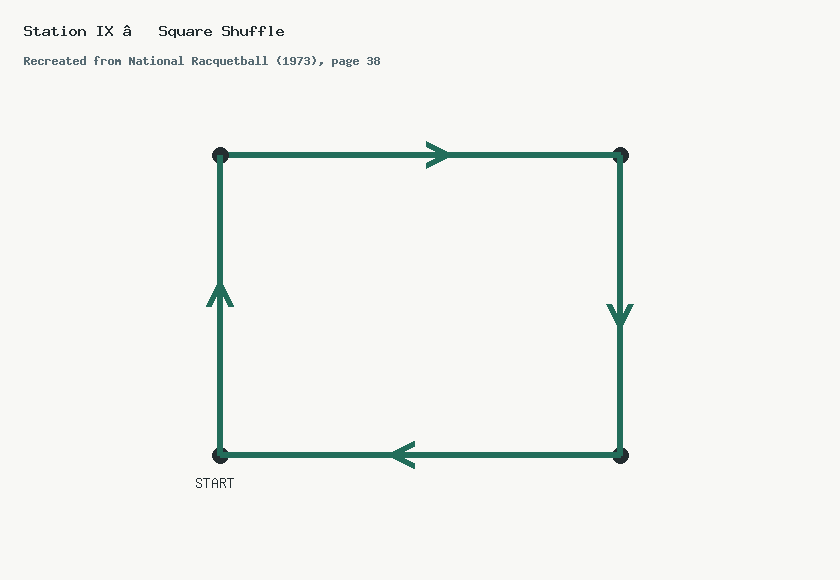
Station IX: Square Shuffle
Equipment – 4 Traffic Cones
Place 4 traffic cones 20 feet apart, in a square. Start at X and run around the cones, facing the same way (wall) all the time. On first leg shuffle to your right; on second leg run forward; on third leg shuffle to your left; on fourth leg, run backward, then reverse the procedure.
Station X: Alternate Toe Touching
Equipment – None
Stand with legs wide apart, touch right hand to left toes, the left hand to right toes, then stand erect.
Station XI: Curls
Equipment – Barbell -20% of body weight
Regular two-hand arm curls.
Station XII: Lunges
Equipment – None
Start with feet together, take two quick forward steps, then thrust right leg forward as far as possible and at the same time thrust right hand forward as well; return to starting position and repeat, using left leg and left hand. This exercise is designed to help you reach as far forward as possible.
Station XIII: Reverse Bench Press
Equipment – Bench, 2-10 lb. Dumbbells
Front lying on bench, face down, arms outstretch, shoulder height, gripp ing the dumbbells on the floor. Keep arms straight and raise the dumbbells as high as possible.
Station XIV: Wrist Curls
Equipment – 5 lb. Dumbbells
Wrist curl is done by keeping the arm still, and with the palm face up the weight is curled toward the body.
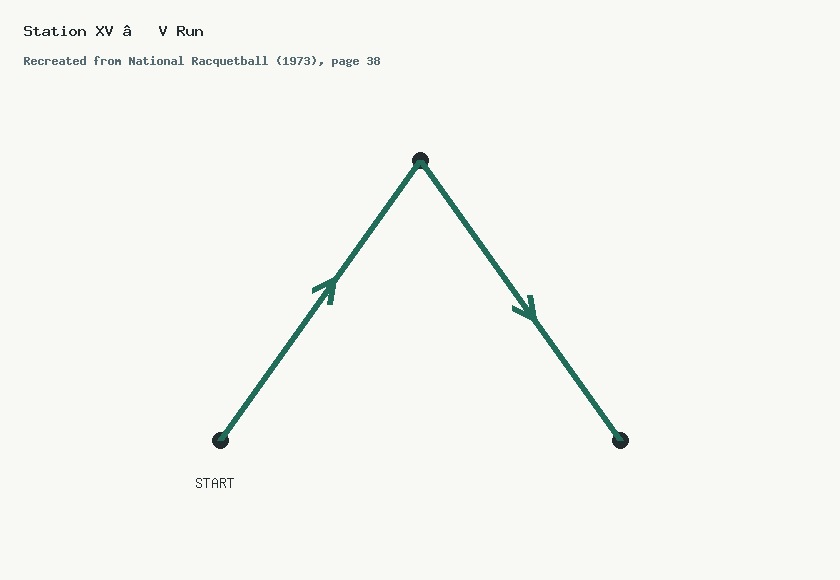
Station XV: V Run
Equipment – Three Traffic Cones
Place traffic cones 20 feet apart so that they form a V. Run along the V and back, always facing the same direction.
An examination of the circuit will show that the exercises are simple and that each one individually is easy to execute. The key to benefitting from the circuit is to work non-stop, attempting to complete all requ ired Training Doses at each station and finishing the 3 circuits within the total time alloted. A shorter version of the circuit can be used by selecting the first 9 stations. For the athlete who wants to start at a lower level, the exercises at these stations will benefit him and as his condition inproves he can add the next 3 or the next 6 stations. Following the completion of circuit training a cooling down phase consisting of very slow jogging and walking is recommended. One key factor in determining a champoinship athlete is that his physical fitness level be high. Now is the time to start preparing for the future championships.
Originally published in National Racquetball, September 1973, pp. 36–38. By Saul Ross.